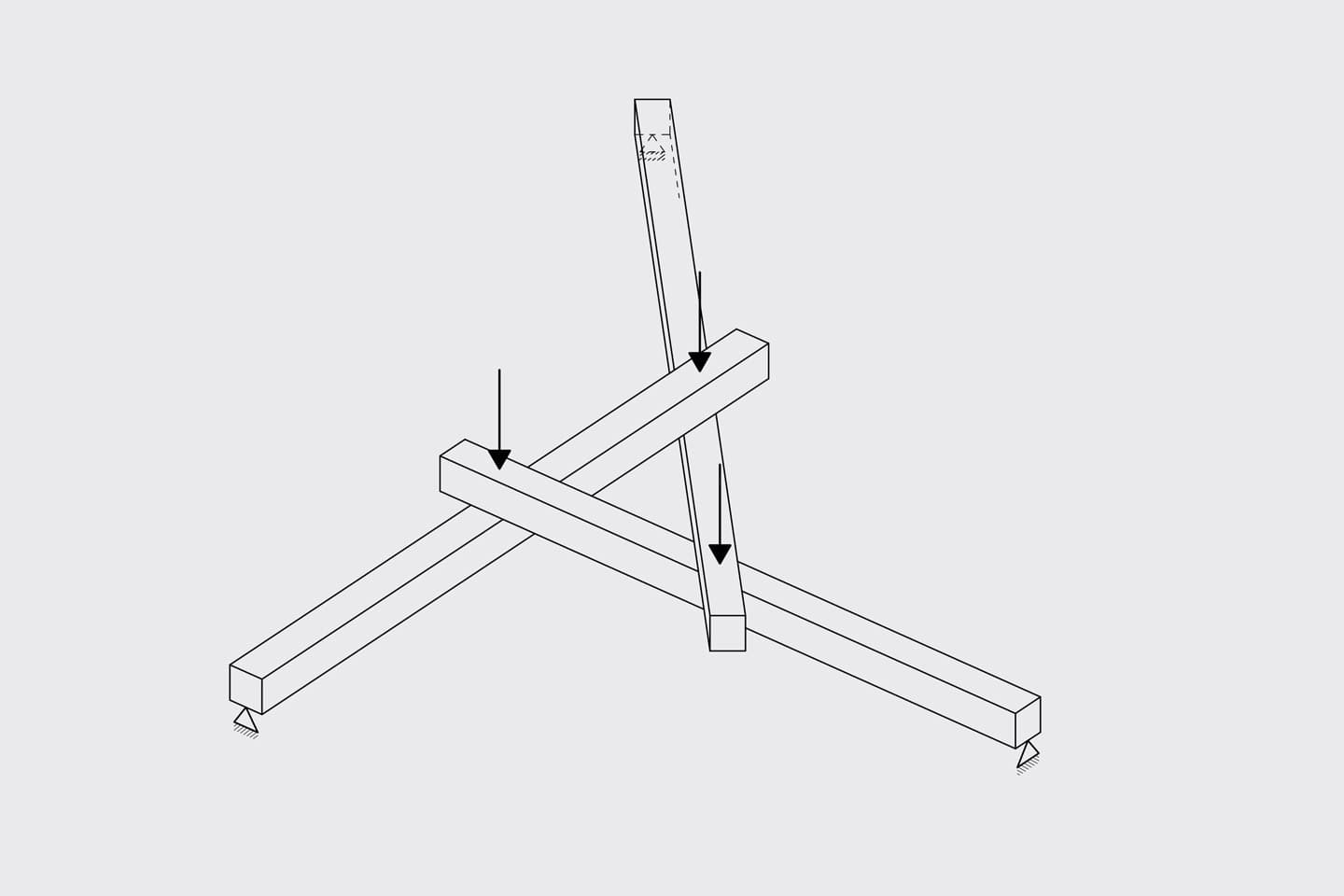
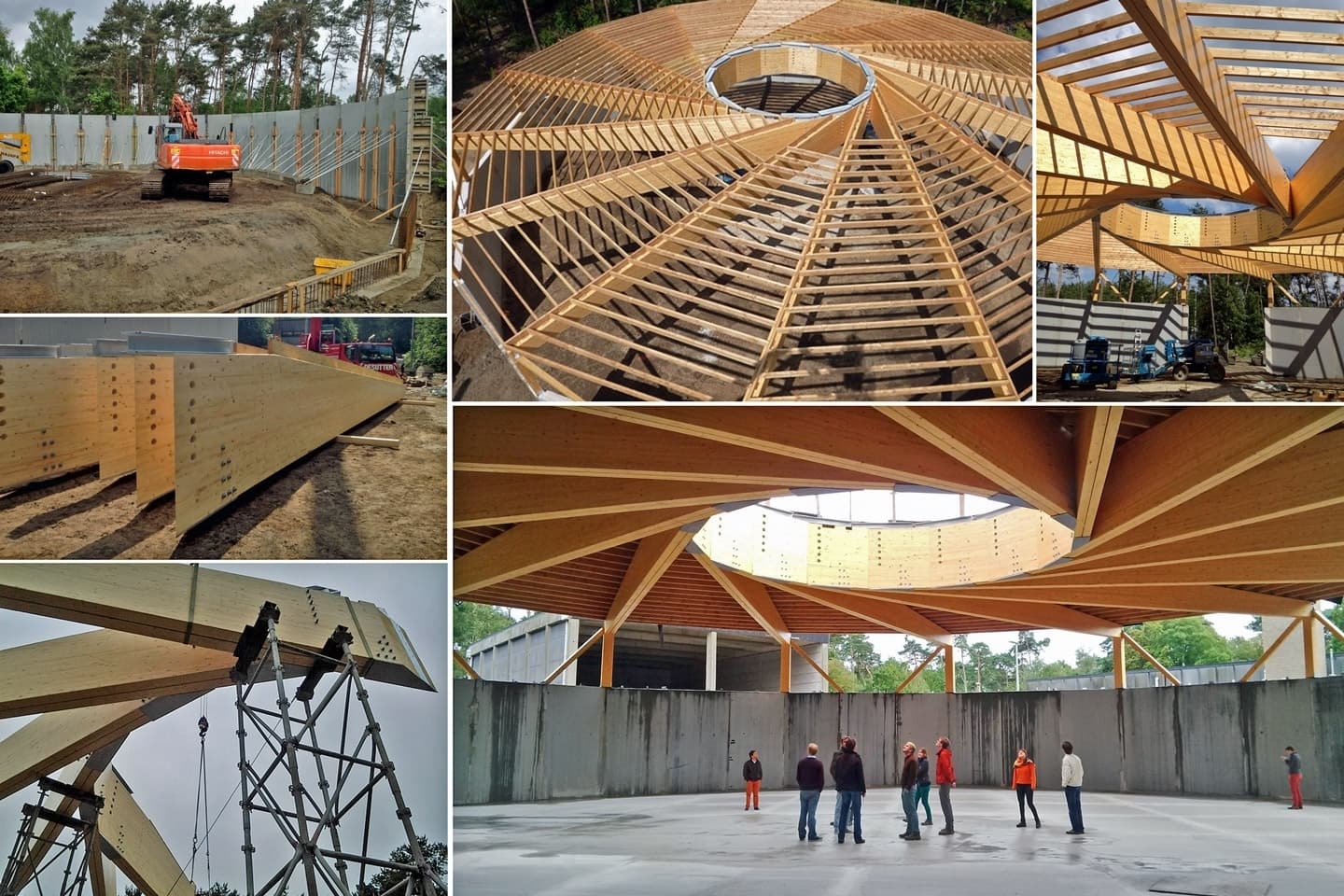
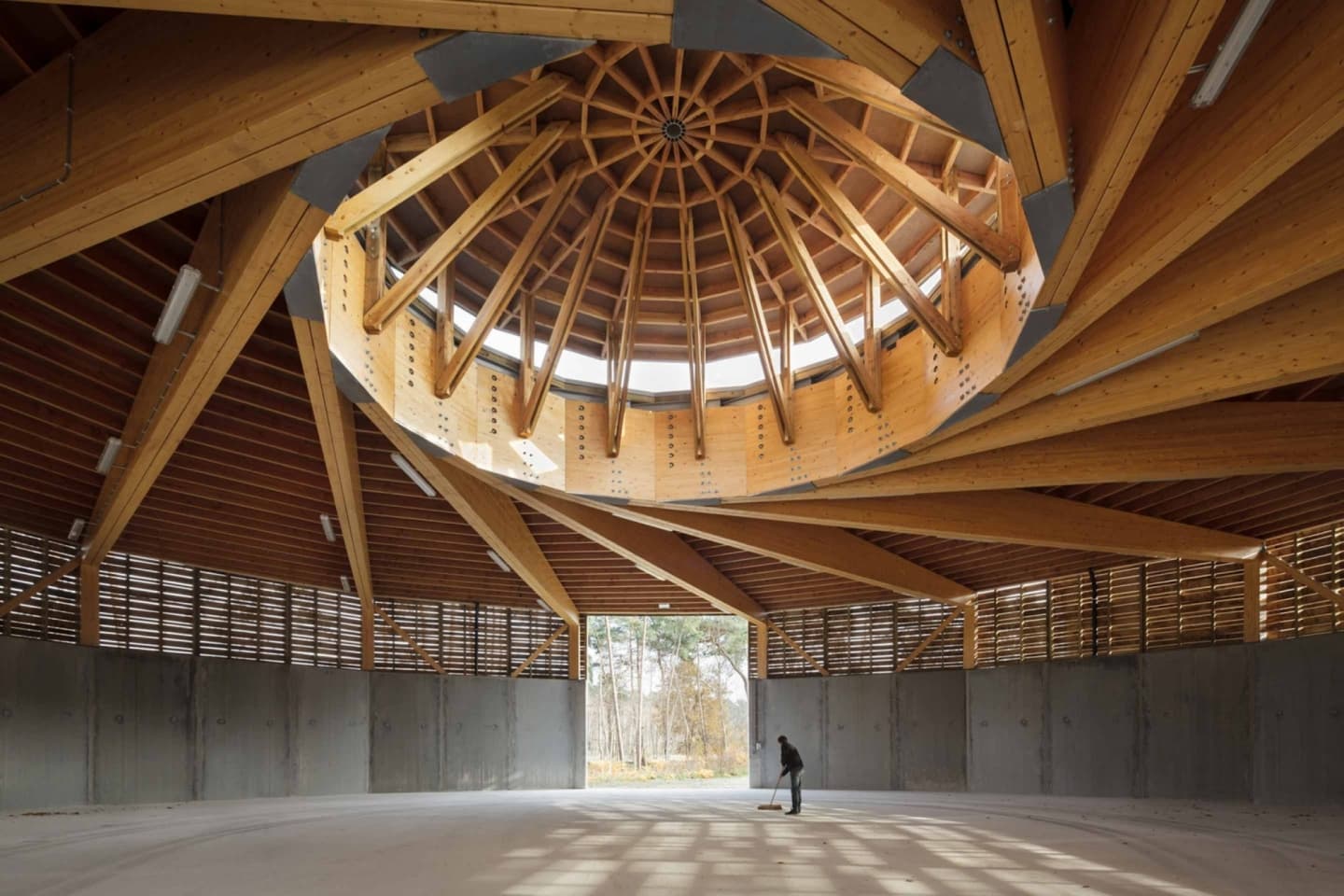

The salt warehouse is nothing more than a concrete ring topped with a timber roof structure. It is cleverly positioned on a small, inconspicuous site within the turning radius of the salt spreaders, allowing for efficient loading. At the same time, the circular plan ensures that the walls embrace the maximum possible surface area along their length and that there are no corners where salt could undesirably accumulate. The roof structure derives directly from the plan’s geometry and, counterintuitively, is based on a simple structural principle. Each of the fifteen beams acts as a two-span beam, supported at one end on the outer ring and at the other centrally on the “next” spoke, and each is loaded with a point load from the “previous” beam. This arrangement avoids the need for a central column, allows for natural air circulation, and the central oculus provides daylight. Timber is inherently less sensitive to condensation and to an aggressive environment. The salt warehouse exemplifies a design process in which engineer and architect collaborated closely. The roof arrangement clearly offers structural and functional advantages, but this does not imply that the structure is strictly “necessary.” The structure is not the only solution dictated by boundary conditions; rather, it is the outcome of an intensive design process. The choice of this structure was made consciously, with the goal of achieving a strong architectural gesture.